Objective 3. Workforce and Network Development
Develop the capacities and public engagement necessary to implement the strategy
TARGET 14: Trained people working in facilities, according to local needs are sufficient to achieve the goals of the Hawai‘i Strategy for Plant Conservation.
The Targets of the Strategy are individually and collectively important, with several impacting each other. They span a wide range of topics, such as traditional in situ protection, ex situ conservation, education and outreach, incorporating indigenous knowledge and innovations, and workforce capacity. As such, they require a diverse set of partners actively participating to make progress. The achievement of the 20 Targets requires considerable capacity-building, particularly to address the need for conservation practitioners trained in a range of disciplines. Progress toward this target is considered key for the successful implementation of the Hawaiʻi Strategy for Plant Conservation, as well as the Global Strategy for Plant Conservation (Target 15). However, the Global Strategy’s report noted that based on available information progress made across the world was insufficient to meet the Target by 2020, and it is possible that capacity building opportunities are declining in some areas. Progress is measured through the number of full-time employees working throughout the state in different position categories, by island.
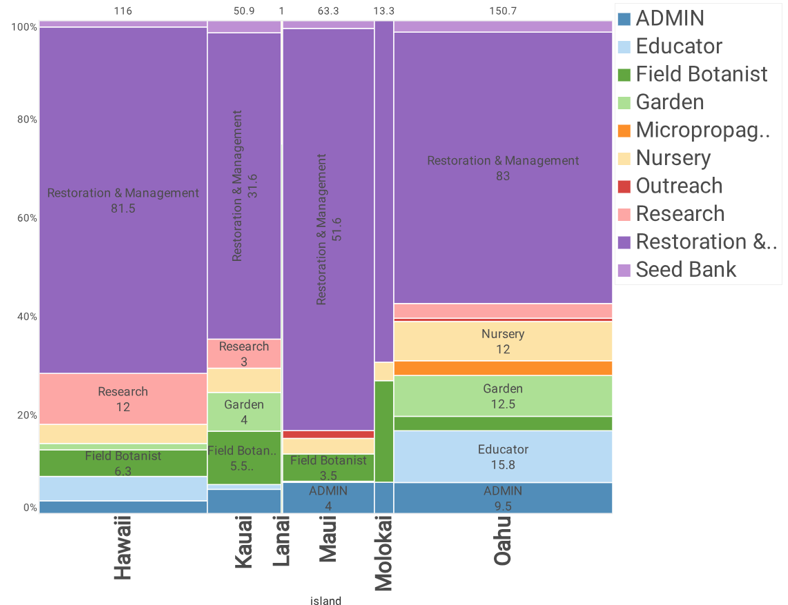
437 FTE tracked in 2020
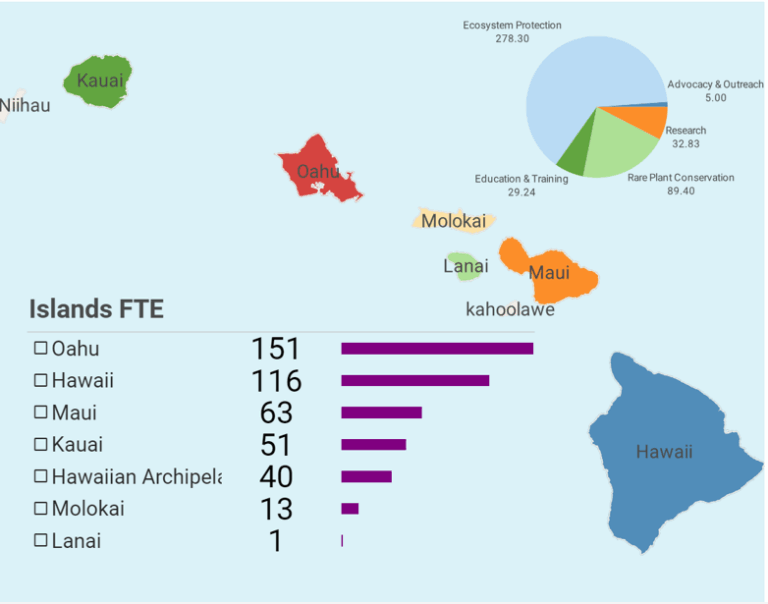
In a 2020 survey, 39 partner organizations were asked to describe their full-time equivalent (FTE) positions. Laukahi’s partners have at least 437 trained full-time staff working on plant conservation throughout the state. Laukahi staff mapped these 437 FTE out by their higher-level functions: Advocacy/Outreach, Ecosystem Protection, Education and Training, Rare Plant Conservation, and Research. Organizations were asked to further describe employee functions as administrative, education, restoration, outreach, or in ex situ work (seed bank, garden, nursery, and/or micropropagation). Findings from the survey demonstrate a need for additional staff and funding for operations to meet all Strategy Targets, and Laukahi is working to quantify local needs to meet Targets 17-20. The University of Hawaiʻi’s Economic Research Organization (UHERO) compiles data periodically on “green jobs” in Hawaiʻi (which encompasses positions in Natural Resource Management, Energy, and Agriculture). In 2018, UHERO reported 4,697 positions in Natural Resource Management (or 45 jobs on average per organization), with a standard deviation of 156. This increased by 1,154 FTE positions from the last assessment in 2014. Moving forward, they expect a modest growth rate of 0.54% over the next five years, equivalent to 127 FTE positions. However, this was before COVID-19 impacted our state. Plant conservation positions make up about 10% of the total available jobs in Natural Resource Management. We should note that some facilities are specific to on-island services, and others provide services to the entire state. Lyon Arboretum is on Oʻahu, but the Hawaiian Rare Plant Program serves all islands. Additionally, the National Tropical Botanical Garden on Kauaʻi contains collections from across the Pacific. We are able to identify shortages in staff and/or facilities across the state using this analysis. For instance, we see a correlation between staff shortages on islands that also lack habitat protection (Target 7),and a lack of researchers on Lānaʻi or Molokaʻi to an absence in research on the impacts of rodents on Lānaʻi or Molokaʻi (Target 4). More importantly, how can we use this information to inspire a surge in capacity building? Laukahi shares this information to attain a higher percentage of FTE in Natural Resource Management and to address limitations that would prevent the completion of Strategy Targets.